 Orders placed between June 24 and July 5 may experience slight processing delays due to inventory reconciliation and warehouse maintenance.


A research compound can look clean on paper and still leave critical questions unanswered. In the HPLC versus mass spectrometry discussion, the real issue is not which instrument sounds more advanced. It is which analytical method can answer the specific question behind a purity claim, identity claim, or certificate of analysis.
For researchers evaluating SARMs, peptides, nootropics, and other performance-oriented compounds, testing is a quality-control decision. A serious supplier should understand what its methods measure, where those methods have limits, and why a single percentage on a COA is not the entire story.
HPLC Versus Mass Spectrometry: The Core Difference
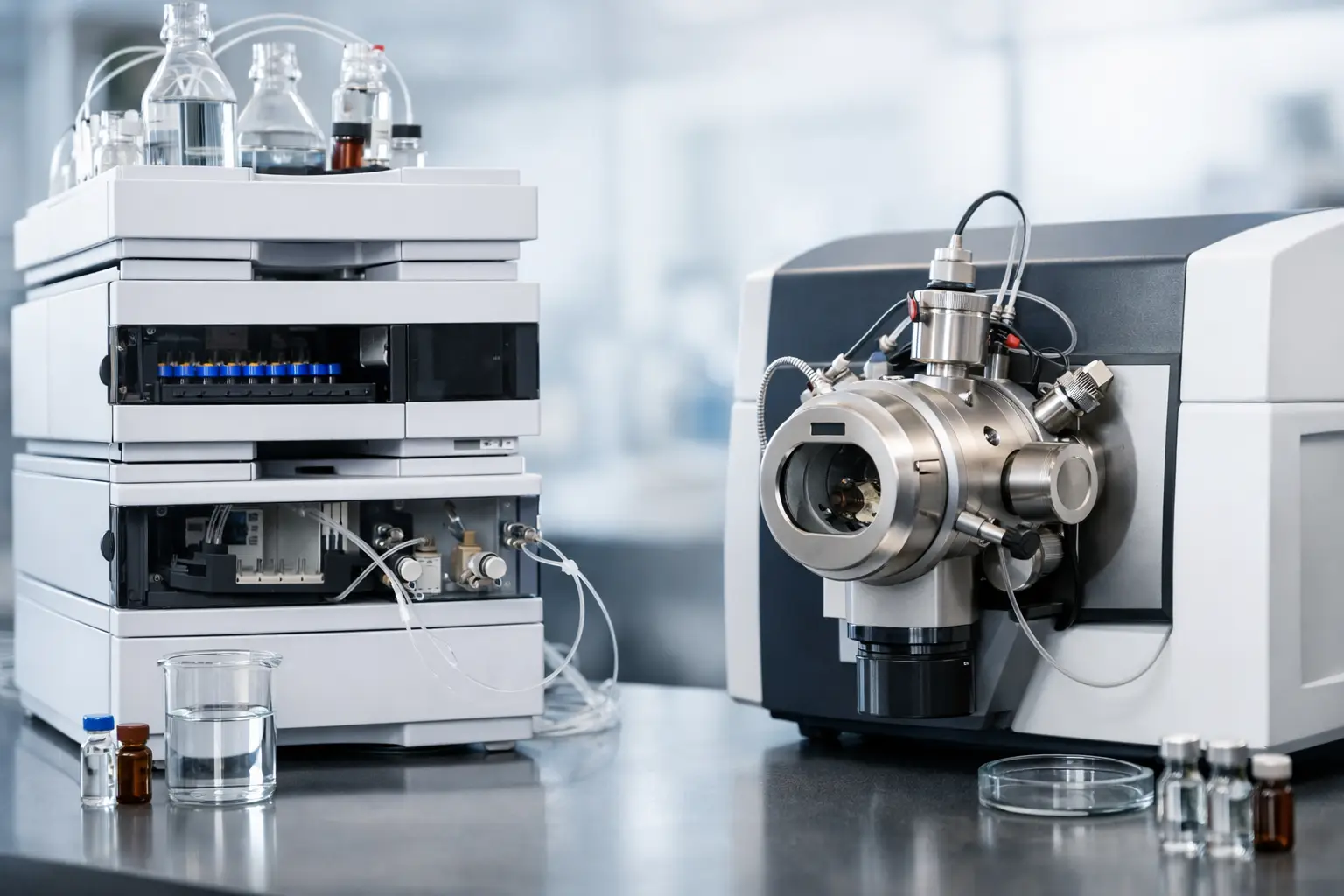
High-performance liquid chromatography, or HPLC, separates components in a liquid sample. The instrument pushes a prepared sample through a column, where individual compounds move at different rates based on their chemistry. A detector records those separated signals as peaks on a chromatogram.
Mass spectrometry, commonly called MS, measures ions by their mass-to-charge ratio. Rather than primarily showing when a component comes off a chromatography column, it provides molecular-weight information that helps determine what that component may be. MS is often coupled with liquid chromatography, creating LC-MS or LC-MS/MS workflows that separate a mixture before identifying or characterizing its components.
Put simply, HPLC is exceptionally useful for determining how much of a sample is made up of separated components. Mass spectrometry is exceptionally useful for determining whether a signal is consistent with the molecular identity expected. They overlap, but they are not interchangeable.
That distinction matters when a label says a vial contains a particular peptide or a powder is represented as a specific research compound. A purity percentage is valuable. Identity confirmation is valuable. The strongest quality strategy recognizes that these are separate analytical questions.
What HPLC Does Well
HPLC is a workhorse method for purity assessment and quantitative testing. When a reference standard and validated method are available, it can measure the amount of a target analyte with high repeatability. It is widely used because it is efficient, scalable, and well suited to routine lot testing.
For a supplier, HPLC can reveal whether a main peak dominates the chromatogram and whether additional peaks suggest impurities, degradants, residual starting materials, or related compounds. In a well-developed method, the area represented by the primary peak can support an assay or purity result.
HPLC is especially practical when consistency is the priority. If the same compound is tested lot after lot under the same established conditions, the method creates a clear basis for comparing batches. That is central to disciplined quality control, particularly for compounds where storage, handling, moisture exposure, or manufacturing variation can affect the final material.
Still, an HPLC chromatogram should not be treated as a molecular fingerprint by itself. A peak appearing at an expected retention time does not independently prove its identity. Different chemicals can sometimes produce similar retention behavior under a given set of conditions. UV detectors also respond differently depending on a molecule’s structure, so peak area is not automatically identical to mass percentage without appropriate method design and calibration.
HPLC Limits to Keep in View
HPLC results depend on the method. Column chemistry, mobile phase, wavelength, temperature, sample preparation, integration settings, and reference standards all influence the output. A purity figure without the supporting context may be useful, but it is not the same as a complete analytical package.
For peptides, another consideration is that closely related sequences, truncations, oxidation products, and other variants can be challenging to separate. A carefully optimized HPLC method may distinguish them. A generic method may not. The quality of the method is every bit as relevant as the presence of the instrument.
What Mass Spectrometry Does Well
Mass spectrometry adds a different level of confidence. By measuring mass-to-charge ratios, MS can help verify whether the sample contains a molecule with the expected molecular mass. For many research compounds, this is a direct and powerful identity check.
With LC-MS, chromatography separates the sample first and the mass spectrometer analyzes the resulting components. This pairing is valuable when a sample may contain multiple substances or when a small impurity must be distinguished from the main analyte. MS can often detect compounds at lower levels than common optical HPLC detectors, although sensitivity always depends on the analyte, instrument, sample matrix, and method.
Tandem mass spectrometry, or MS/MS, goes further. The instrument selects an ion and fragments it, producing a pattern that can provide structural evidence. This is particularly useful for distinguishing compounds with similar molecular weights and for characterizing peptides. In peptide analysis, accurate mass plus fragmentation data can support sequence-related confirmation far more strongly than retention time alone.
For a quality-focused research supplier, MS is a serious tool for guarding against a basic but costly failure: testing material for purity without adequately confirming that the main component is actually the intended compound.
Where MS Has Limits
Mass spectrometry is not a magic stamp of authenticity. An observed mass consistent with the target does not always rule out isomers, closely related analogs, or co-eluting compounds. Some molecules ionize poorly, while matrix effects can suppress or distort signals. Quantitation by MS can also be more complex than it appears, especially without stable-isotope internal standards and properly validated calibration.
MS systems require experienced interpretation. Adducts, multiple charge states, in-source fragmentation, background contaminants, and data-processing choices can complicate results. In other words, a mass spectrum can be highly informative, but only when the method and analyst are capable of turning instrument output into defensible data.
When HPLC Is the Better Choice
Choose HPLC when the central question is routine purity, assay, or batch-to-batch consistency. It is a strong fit for established compounds with a validated analytical method, available standards, and a need to process multiple lots efficiently.
HPLC is also highly relevant when evaluating visible impurity profiles. A clean, well-resolved chromatogram can show whether the expected main component is present at a dominant level and whether meaningful secondary peaks require investigation. For ongoing quality programs, it offers a practical foundation for release testing.
That does not mean HPLC is the cheaper shortcut or the lesser method. For many controlled quality questions, it is exactly the right method. The mistake is asking HPLC alone to establish more than the method can support.
When Mass Spectrometry Is the Better Choice
Use mass spectrometry when identity confidence is the priority, when the compound is novel or complex, or when unexpected peaks need characterization. It is particularly valuable for peptide verification, low-level impurity investigation, degradation studies, and cases where several related molecules may be present.
MS is also the stronger option when a sample must be screened for a broad range of unexpected substances. A standard HPLC-UV method only sees what it is configured to detect effectively. LC-MS can provide more selective information and can help analysts trace an unknown signal toward a likely molecular identity.
For high-value research materials, the best answer is often not HPLC or MS. It is HPLC and MS, used with a defined purpose. HPLC can quantify the primary material and map its impurity profile, while MS can provide identity-focused evidence for the target and selected impurities.
How to Read a COA With More Discipline
A certificate of analysis should be treated as evidence, not marketing decoration. Start by checking whether the COA identifies the specific lot or batch being sold. A document without a matching lot number has limited value because it may not represent the material in hand.
Next, identify the stated test method. “HPLC” is more informative than an unsupported purity claim, while “LC-MS” or “MS” signals an identity-oriented method. The most credible documentation clearly separates assay or purity testing from identity testing rather than presenting one result as proof of everything.
Look for the analyte name, reported result, test date, laboratory details, and an understandable pass or fail specification. If the material is peptide-based, molecular-mass confirmation and peptide-specific characterization may carry substantial weight. If it is a small molecule, chromatographic purity plus mass confirmation often provides a more complete view than either result alone.
Be cautious with oversimplified claims. “99% pure” does not reveal the identity of the remaining 1%, the method’s detection limits, whether the sample was tested as received, or whether the result applies to the exact current lot. High purity is a meaningful standard, but professional sourcing depends on traceability, method fit, and consistent documentation.
The Standard That Matches Serious Research
There is no single winning instrument in HPLC versus mass spectrometry. HPLC earns its place through repeatable separation and quantitation. Mass spectrometry earns its place through molecular insight and identity confidence. Their value changes with the compound, the potential risks, and the question a researcher needs answered.
For buyers who demand lab-tested, professionally sourced research materials, the right expectation is not a flashy acronym. It is testing that matches the claim. Ask whether the data establishes purity, identity, or both, then choose suppliers whose quality documentation is specific enough to stand behind the material they sell.