 Orders placed between June 24 and July 5 may experience slight processing delays due to inventory reconciliation and warehouse maintenance.


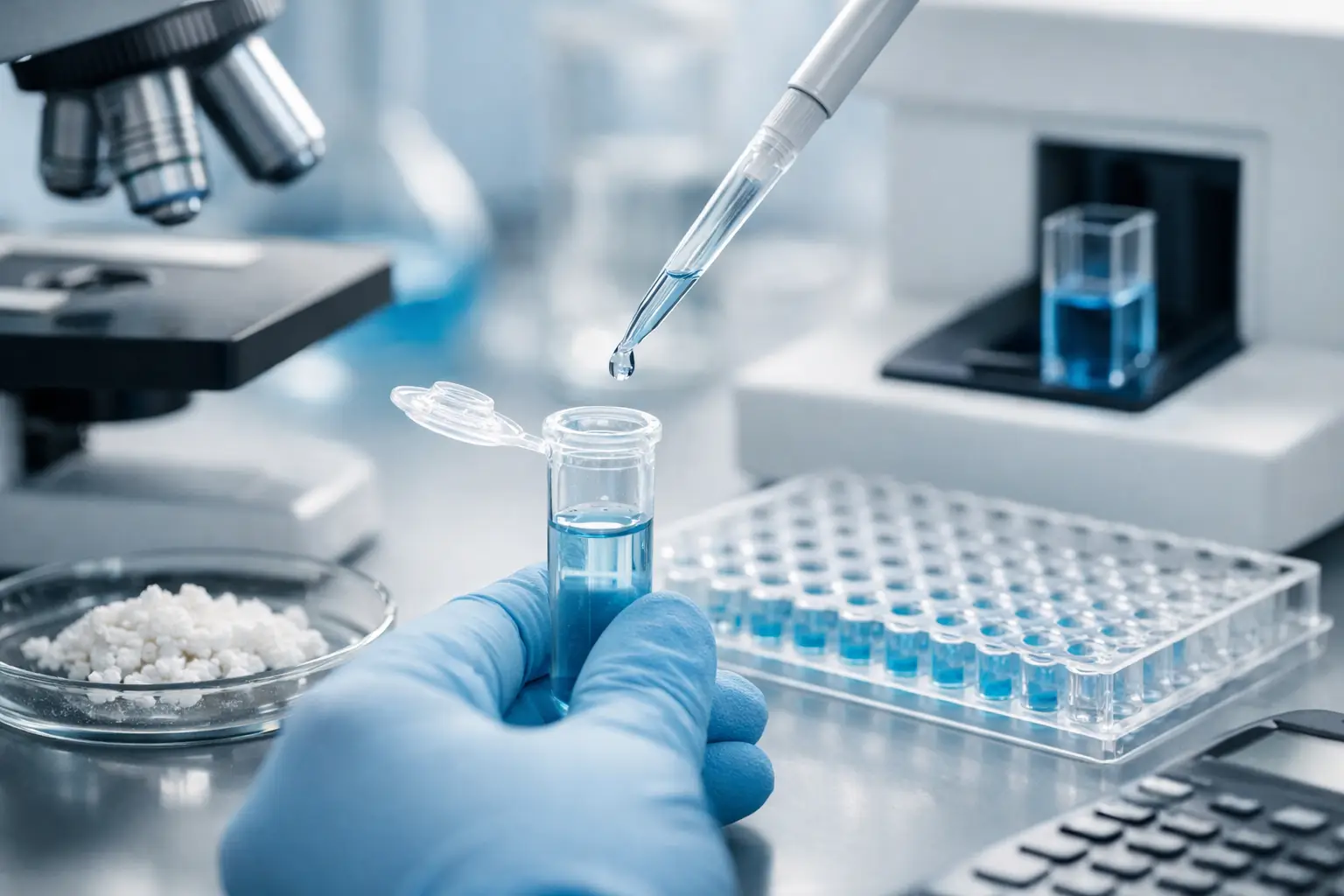
A peptide vial label tells you how much material is present. It does not, by itself, tell you the concentration of the solution in front of you. That distinction is where avoidable calculation errors begin. Knowing how to calculate peptide concentration means turning a verified peptide mass and a measured final volume into a number you can document, reproduce, and use consistently across research work.
For serious research buyers, precision starts before any calculation. A concentration value is only as dependable as the identity, purity documentation, mass stated on the vial, solvent selection, and volume measurement behind it. Lab-tested material and disciplined handling create the foundation. The math confirms what is actually in solution.
Concentration starts with amount and final volume
The most common way to express peptide concentration is mass per volume, usually milligrams per milliliter (mg/mL) or micrograms per milliliter (mcg/mL). The core equation is straightforward:
Concentration = mass of peptide / final solution volume
If a vial contains 5 mg of peptide and the final volume after reconstitution is 2 mL, the calculation is:
5 mg / 2 mL = 2.5 mg/mL
That solution contains 2.5 mg of peptide in every 1 mL. Converting to micrograms makes the same concentration easier to use in protocols written at smaller scales:
2.5 mg/mL × 1,000 mcg/mg = 2,500 mcg/mL
The science is simple. The discipline is in using the actual final volume, maintaining units correctly, and recording every measurement. A vial containing 5 mg does not become a 5 mg/mL solution unless the final volume is exactly 1 mL.
How to calculate peptide concentration after reconstitution
Lyophilized peptides are commonly supplied as a dry powder. Once an appropriate research solvent is added, the dry mass is distributed throughout the total liquid volume. To calculate concentration accurately, use the mass listed for the peptide and the volume of solvent added.
For example, a vial containing 10 mg of peptide is reconstituted to a final volume of 4 mL:
10 mg / 4 mL = 2.5 mg/mL
If that same 10 mg vial is reconstituted to 1 mL instead, the result changes substantially:
10 mg / 1 mL = 10 mg/mL
The amount of peptide has not changed. The concentration has. Less liquid creates a more concentrated stock; more liquid creates a less concentrated stock. Neither approach is automatically better. The right concentration depends on the validated research protocol, the required measurement resolution, peptide solubility, and the intended storage and handling conditions.
Use the term final volume with care. In routine practice, researchers often calculate from the volume of diluent added. For higher-precision work, especially where volume recovery or formulation behavior matters, confirm the actual final solution volume rather than assuming it exactly matches the added solvent volume.
Keep your units under control
Most peptide concentration mistakes are unit mistakes. A clean calculation requires every number to speak the same language before you divide.
One milligram equals 1,000 micrograms. One milliliter equals 1,000 microliters. This means a concentration of 1 mg/mL is numerically identical to 1 mcg/mcL.
That relationship is useful because it simplifies common conversions. A solution at 2.5 mg/mL is also 2.5 mcg/mcL. In a 100 mcL volume, it contains 250 mcg. The calculation is:
2.5 mcg/mcL × 100 mcL = 250 mcg
Do not mix mg with mcL or mcg with mL unless you convert first. The numbers may look plausible while being off by a factor of 1,000. That is not a minor discrepancy. It can invalidate a full set of research observations.
A practical documentation line should state all three components: peptide identity, concentration, and solvent or vehicle. For example: peptide identifier, 2.5 mg/mL, final volume 2 mL, prepared on a specified date. This creates a record that can be checked later instead of relying on memory or an unlabeled vial.
Calculate molar concentration when molecular weight matters
Mass concentration is convenient, but molar concentration is often more meaningful when comparing different peptides or designing an assay. Molarity expresses the number of molecules in a known volume and is typically reported as molar (M), millimolar (mM), micromolar (uM), or nanomolar (nM).
The formula is:
Molarity (M) = mass in grams / molecular weight in g/mol / volume in liters
Assume a peptide has a molecular weight of 5,000 g/mol. A 5 mg sample is reconstituted in 2 mL.
First, convert mass and volume:
5 mg = 0.005 g 2 mL = 0.002 L
Then calculate moles:
0.005 g / 5,000 g/mol = 0.000001 mol
Finally, divide by volume:
0.000001 mol / 0.002 L = 0.0005 M
That is 0.5 mM, or 500 uM.
This is why molecular weight cannot be ignored when working in molar units. Two peptides may each be prepared at 1 mg/mL, but if their molecular weights differ, their molar concentrations will differ as well. Mass alone does not tell you molecular equivalence.
Always use the molecular weight specific to the material being studied. Modifications, salts, counterions, labels, and sequence changes can affect the correct value. If the supplier documentation identifies a particular form, calculate from that documented form rather than a generic sequence estimate.
Use C1V1 = C2V2 for dilutions
Once you have a confirmed stock concentration, the standard dilution equation helps prepare a lower-concentration working solution:
C1V1 = C2V2
C1 is the stock concentration, V1 is the stock volume needed, C2 is the desired concentration, and V2 is the desired final volume.
Suppose a stock is 2.5 mg/mL and a research method requires 1 mL of a 0.1 mg/mL working solution. Solve for V1:
V1 = (C2 × V2) / C1
V1 = (0.1 mg/mL × 1 mL) / 2.5 mg/mL = 0.04 mL
Convert 0.04 mL to microliters:
0.04 mL × 1,000 = 40 mcL
The working solution requires 40 mcL of stock, then compatible diluent added to reach a final volume of 1 mL. The dilution factor is 25-fold.
This equation works only when concentrations use matching units. If the stock is in mg/mL and the target is in mcg/mL, convert one value before solving. It takes seconds and protects the integrity of the entire preparation.
Precision failures that compromise the calculation
The formula does not correct for weak technique. Even perfect arithmetic can produce an unreliable result when the inputs are uncertain.
First, do not confuse labeled peptide mass with active peptide content if purity or salt form must be accounted for in the protocol. A stated net mass, a purity percentage, and an active-content calculation are related but not interchangeable. Follow the analytical documentation and protocol requirements for the level of correction needed.
Second, verify your pipetting range. A pipette is most reliable within its specified operating range. Trying to measure a very small volume with an oversized instrument introduces unnecessary variability. If the required stock aliquot falls near the lower limit of available equipment, a serial dilution may provide better control than forcing a marginal measurement.
Third, account for incomplete dissolution, evaporation, contamination risk, and unclear labeling. A solution that has not fully dissolved is not a uniform concentration. A vial left open can lose solvent. A container without a preparation date or concentration label becomes an uncontrolled variable.
Finally, treat concentration as a preparation value, not a promise of stability. Peptide behavior depends on sequence, solvent system, temperature, light exposure, freeze-thaw history, and storage duration. A correctly calculated solution still requires handling conditions appropriate to the compound and validated research method.
Build concentration checks into your workflow
High-standard research preparation is repeatable by design. Before recording a final concentration, verify the vial mass, confirm the solvent and volume, standardize units, and independently rerun the calculation. For sensitive work, have a second trained person review the math or compare it against a controlled calculation sheet.
ASN-LABS customers who prioritize tested, consistently sourced research materials should apply the same standard after delivery: protect traceability from the vial label through final preparation. Store calculations with the batch documentation, record any dilution steps, and label each working solution clearly.
The strongest concentration calculation is not the fastest one. It is the one another researcher can reconstruct exactly, verify confidently, and use as a controlled foundation for the work ahead.